
Tire School
Our buying guide helps you choose the right tire – size, season, EU label and the rules you need to know.
How to read your tire size
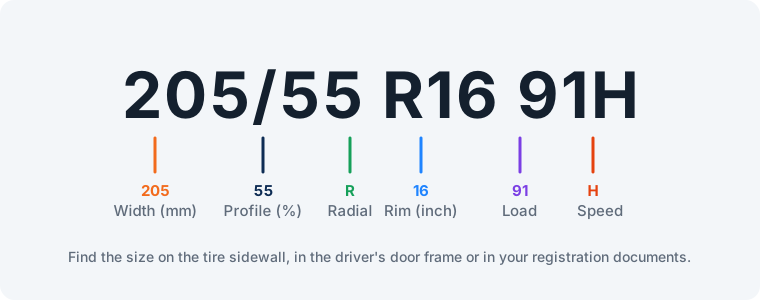
The tire size is printed on the sidewall. In the example 205/55 R16 91H, 205 is the width in millimetres, 55 is the profile (sidewall height as a percentage of the width), R means radial construction and 16 is the rim diameter in inches. 91 is the load index (615 kg per tire) and H the speed rating (max 210 km/h).
Always choose the same size, a load index at least as high and an approved speed rating for your car. You can find permitted sizes in your registration certificate.
Summer tires
A harder compound for temperatures above +7 °C. Precise steering, short braking distances and low rolling resistance.
Winter tires
A soft compound and lots of sipes for grip on snow and ice. Choose studded or Nordic friction tires depending on how and where you drive.
All-season tires
A compromise for milder climates. Must carry the 3PMSF snowflake symbol to count as winter tires in Sweden.

Tires for electric cars
Electric cars are heavier and have instant torque. EV tires have reinforced carcasses (often XL / HL load index), low rolling resistance for longer range and noise-reducing foam or tread designs.
The EU tire label
All new car tires sold in the EU carry a label with three ratings:
- Rolling resistance (A–E): affects fuel consumption and EV range. A is best.
- Wet grip (A–E): braking on wet roads. The difference between A and E can be over 18 metres from 80 km/h.
- External noise (dB, class A–C): lower is quieter.
The label can also show the snowflake symbol (3PMSF) for snow grip and an ice grip symbol for Nordic winter tires.
Tread depth – when to replace
The legal minimum in Sweden is 1.6 mm for summer tires and 3 mm for winter tires during the winter period. We recommend replacing summer tires at 3 mm and winter tires at 4–5 mm for safe grip. Tires older than 6–8 years should be replaced even if the tread looks good.
Winter tire rules & dates
- Winter tires are mandatory 1 December – 31 March when winter road conditions apply.
- Studded tires are allowed 1 October – 15 April (longer if winter conditions apply).
- Some city streets ban studded tires – check your municipality.
Change tires yourself – step by step
- Park on a flat surface, apply the handbrake and loosen the wheel nuts half a turn.
- Lift the car with a jack at the jacking point shown in the owner's manual.
- Remove the nuts and the wheel. Mark its position (front/rear, left/right).
- Fit the new wheel, tighten the nuts crosswise by hand, lower the car and tighten to the correct torque.
- Check tire pressure and re-tighten the nuts after 50–100 km.
Tires that are not mounted on rims need to be fitted and balanced by a workshop.